
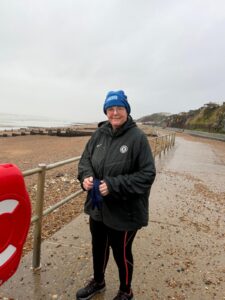
When our Services Coordinator, Maggie, first suggested a Pier to Pier Challenge, it wasn’t only born out of wanting to create a fundraising event or walk our coastal route. It came from lived experience as an unpaid Carer, and wanting to help more people who are Carers.
For Maggie, caring is not just something she supports professionally every day in her role with us; it is something that has shaped her life, her resilience, and her understanding of what unpaid Carers truly face.
A Caring Journey That Began Overnight
“My wife was first diagnosed with MS in 1998,” she explains. “It happened suddenly one day when we were out with friends. When she tried to stand up, she couldn’t.”
From that moment, their lives changed. Initially managing with a wheelchair and a zimmer, her wife’s condition remained relatively stable for many years. But over the last seven years there has been a rapid decline. Today, she requires full‑time wheelchair use, is hoisted for transfers, is PEG‑fed and catheterised, and needs constant care.
“I care for my wife,” she says simply. “That’s my relationship.”
What Caring Really Involves
Alongside professional carers who support with personal care, the rest fell to her.
“I manage everything else — the house, the finances, medication, managing external carers, equipment, appointments. You never stop thinking, planning, adapting.”
Even while working four days a week, she is always on call, ready to respond if something goes wrong outside of her professional role.
“The biggest impact on my day‑to‑day life is that I can never truly switch off. Everything is organised around my wife’s needs. Even if I manage to go away for a day, I’m always ready to come home if needed.”
This constant vigilance is familiar to so many unpaid Carers — and it’s why this challenge exists.
The Emotional Cost of Caring
When looking at the rewards of caring, Maggie says honestly;
“I don’t know if I find it rewarding. I do it because I love her. Every day we still have together is precious.”
What is hardest is the emotional exhaustion.
“Watching the person you love disappear in front of you. Managing carers coming in and out every day. Never being uninterrupted. Never being able to just relax in your own home.”
She speaks of feeling invisible — as though the house, her time, and even her identity had slowly become defined only by care needs.
Learning to Accept Support
Like many Carers, she was slow to accept help. But counselling, personal reflection, and small acts of self‑care helped her survive.
Long walks — sometimes 10 miles — became moments of quiet. Sharing a campervan allowed for short bursts of respite. And, importantly, she began to ask for — and accept — support from friends.
“I’ve learned I’m stronger than I ever thought. But strength shouldn’t stop you asking for help.”
Turning Experience into Action
This deep understanding of caring is what led her to spearhead our Pier to Pier Challenge — a fundraiser that reflects the realities of caring rather than pretending everyone starts from the same place.
And fittingly, the challenge will end being joined by her wife, Lizzie. Although Lizzie now lives in a care home, The Laurels in Hastings, she will be taking part in the final section of the Pier to Pier Challenge in her wheelchair, supported by the care home team.
It is a visible reminder that Carers and cared‑for people are still part of life, community and hope — not hidden away.
“This challenge is about every Carer who feels invisible,” she says. “About adapting, not giving up. About saying: we are still here.”
A Message to Other Carers
Her advice to anyone new to caring is simple:
“Don’t become invisible. You matter. You are invaluable. Make time for yourself and don’t feel guilty. You can only be the best Carer you can be if you care for yourself too.”
The Pier to Pier Challenge is not just a walk. It is a show of resilience, adaptation, and love — championed by someone who lives the reality of caring every single day.
Thank you and good luck to Maggie, Lizzie and all the walkers on April 19th!